 octopushas3hearts
Related Articles
Teaching children responsibility at home is one of the most valuable things parents can do for their future. I believe responsibility is not something children simply understand as they grow older. It is a skill they learn through daily experiences, simple expectations, and consistent guidance from parents.
Children who learn responsibility at home gradually become more independent, organized, and confident. They begin to understand that their choices have consequences and that every family member has a role to play. The good thing is that teaching responsibility does not require complicated lessons. Everyday household activities can become excellent learning opportunities.
In my view, the best approach is to start small, remain patient, and give children responsibilities that match their age and abilities.
Why Responsibility Is Important for Children
Responsibility helps children develop important life skills. When a child is responsible for putting away toys, keeping school supplies organized, or helping with simple household tasks, they learn that their actions matter.
Responsibility can also build confidence. When children complete a task successfully, they experience a sense of achievement. Instead of always depending on parents, they learn that they are capable of doing things themselves.
Another important benefit is that responsibility teaches children to think about other people. A child who helps set the dinner table learns that family life works better when everyone contributes.
These lessons can eventually help children at school, in friendships, and later in their professional lives.
Start With Simple Responsibilities
Parents sometimes expect too much from children too quickly. I think it is better to begin with simple responsibilities that children can understand and complete without becoming overwhelmed.
For younger children, responsibilities may include putting toys in their storage area, placing dirty clothes in a laundry basket, carrying their dishes to the kitchen, or helping arrange books.
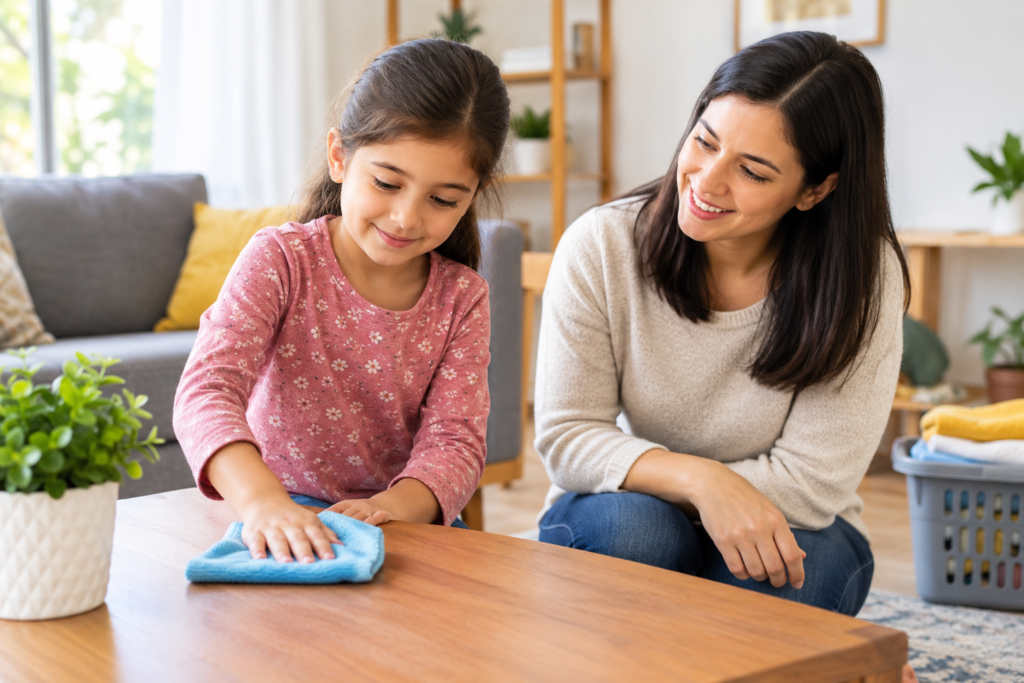
Older children can take on additional tasks such as making their beds, organizing their school bags, watering plants, feeding pets, or helping with household cleaning.
The goal is not to make children responsible for the entire house. The goal is to help them understand that they have certain responsibilities within the family.
Choose Age Appropriate Chores
Age appropriate chores are an important part of teaching children responsibility at home. A task should be challenging enough to teach a skill but reasonable enough for the child to complete successfully.
Young children can usually handle basic cleanup activities with guidance. School age children can often manage personal belongings, simple cleaning tasks, and some kitchen assistance. Teenagers can gradually take responsibility for more complicated household activities.
Parents should consider the child’s maturity, physical ability, attention span, and understanding when assigning chores.
It is also important to remember that children develop at different speeds. One child may be ready for a particular responsibility earlier than another child. Comparing siblings can create unnecessary pressure, so it is better to focus on individual progress.
Explain Why the Task Matters
Simply telling a child to do something may not always teach responsibility. Children understand tasks better when parents explain their purpose.
For example, instead of only saying, “Put your toys away,” explain that keeping toys organized makes the room easier to use and prevents things from getting lost.
If a child helps set the table, explain that everyone is preparing for the family meal. If they put their clothes away, explain that organization helps them find what they need later.
When children understand the reason behind a responsibility, they are more likely to see it as a meaningful part of everyday life rather than a punishment.
Teach by Example
Children learn a great deal by watching their parents. If parents want children to become responsible, they should demonstrate responsibility in their own daily lives.
For example, parents can show children how they organize their schedules, clean after themselves, complete work on time, and take care of household belongings.
I believe this is one of the most effective ways to teach responsibility because children often copy what they see more than what they hear.
Parents do not need to be perfect. Instead, they can openly demonstrate how they handle mistakes. If something is forgotten, they can show children how they correct the problem and move forward.
Create a Consistent Routine
Consistency makes responsibility easier for children. If chores change every day without explanation, children may not know what is expected of them.
A simple household routine can make responsibilities clearer. For example, a child might make the bed in the morning, put school belongings away after returning home, and clean up toys before bedtime.
The routine does not have to be complicated. A short list of regular tasks may be enough.
Consistency also helps children develop habits. Over time, a responsibility that once required reminders can become a normal part of their day.
Give Children Choices
Children often respond better when they have some control over their responsibilities. Instead of assigning every task without discussion, parents can offer limited choices.
For example, you might ask whether your child would rather water the plants or help organize the books. Both choices involve responsibility, but the child gets to participate in the decision.
Giving children choices can encourage cooperation and help them feel that their contribution is valued.
Of course, parents should still set reasonable boundaries. Choice does not mean that children can avoid all responsibilities. It simply gives them an opportunity to participate in deciding how they contribute.
Avoid Doing Everything for Your Child
Parents naturally want to help their children, but doing everything for them can make it harder for them to become independent.
Sometimes children take longer to complete a task, make mistakes, or do something differently from the way an adult would do it. It can be tempting to step in and finish the job.
However, allowing children to try is important.
If a child is learning to organize their room, the result may not be perfect at first. Instead of immediately correcting everything, parents can offer guidance and demonstrate better methods when necessary.
The goal is to help children learn, not to demand perfection.
Use Praise Carefully
Positive encouragement can make children feel proud of their efforts. When a child completes a responsibility, parents can recognize the effort they made.
Instead of only saying, “Good job,” parents can be more specific. They might say, “You remembered to put your books away without being reminded.”
This type of feedback shows children exactly what they did well.
At the same time, children should not feel that every household responsibility requires a reward. Helping at home is part of being a family member. Praise can encourage children, but responsibility should eventually become a normal habit.
Teach Children to Take Responsibility for Mistakes
Mistakes are an important part of learning responsibility. If a child spills something, forgets an item, or leaves a mess, parents can use the situation as a teaching opportunity.
Instead of immediately becoming angry, parents can ask what happened and what can be done to fix it.
For example, if a child spills water, they can help clean it up. If they forget to pack something for school, they can learn to check their school bag the night before.
This teaches an important lesson: mistakes happen, but responsible people try to correct them.
Be Patient During the Learning Process
Teaching children responsibility takes time. A child may forget a chore several times before it becomes a habit.
Parents should expect some resistance, especially when a new responsibility is introduced. Calm reminders are usually more productive than constant criticism.
It is also helpful to avoid giving too many responsibilities at once. Start with one or two tasks and gradually add more as the child becomes comfortable.
Patience allows children to develop responsibility without feeling that household chores are a constant source of stress.
Make Household Responsibilities Part of Family Life
I think children are more likely to accept chores when parents present them as part of family life rather than punishment.
Everyone in a household has responsibilities. Adults have work, bills, cleaning, shopping, and other duties. Children also have age appropriate responsibilities.
This approach helps children understand teamwork.
Families can even work together on certain activities. Cleaning a room, preparing a simple meal, organizing a storage area, or working in the garden can become shared experiences.
These moments can teach responsibility while also creating opportunities for parents and children to spend time together.
Teach Responsibility Beyond Chores
Responsibility at home is not limited to cleaning. Children can also learn responsibility through personal decisions.
They can learn to take care of school supplies, manage their belongings, prepare for the next day, follow household rules, and respect shared spaces.
Older children can gradually learn basic money management, time management, meal preparation, and planning.
These skills can prepare children for greater independence as they grow.
Avoid Using Responsibility as a Punishment
One mistake parents can make is connecting every household task with punishment. If chores are always given when a child misbehaves, the child may begin to view responsibility negatively.
Instead, responsibilities should generally be presented as normal contributions to the household.
Consequences for poor behavior can still exist, but regular chores should have a separate purpose. Children need to understand that taking care of themselves and helping at home is simply part of growing up.
Final Thoughts
Teaching children responsibility at home is a gradual process. It begins with small tasks and grows as children become more capable. Parents do not need complicated systems or strict rules. What matters most is consistency, patience, clear expectations, and a willingness to let children learn through experience.
In my opinion, one of the best things parents can do is give children enough responsibility to feel capable without giving them so much that they feel overwhelmed.
When children learn to care for their belongings, complete simple chores, correct their mistakes, and contribute to family life, they are developing skills that can stay with them for years.
The real purpose of teaching responsibility is not simply to have a cleaner home. It is to help children become confident and independent people who understand the value of effort, reliability, cooperation, and taking care of what matters to them.