 octopushas3hearts
Related Articles



Teaching children to express their feelings is one of the most valuable things parents can do for their emotional development. Children experience many emotions every day, but they do not always have the words to explain what they are feeling. A child may become angry, cry, become quiet, or behave differently simply because they cannot explain what is happening inside them.
In my view, helping children understand and express emotions should start at home. Children need to learn that every feeling is acceptable, even though every behavior is not. When parents create a safe environment for talking about emotions, children gradually become more comfortable sharing their thoughts and feelings.
Why Children Need to Learn About Feelings
Children are still developing their emotional awareness. They may know that they feel bad or upset, but they may not understand whether they are angry, disappointed, worried, lonely, embarrassed, or tired.
When children cannot express their feelings, they may communicate through behavior instead. For example, a child who feels frustrated may shout. A child who feels worried may avoid a situation. A child who feels left out may become quiet.
Teaching children to express their feelings gives them healthier ways to communicate. It can also help parents understand what their child needs.
Emotional expression is not about making children talk all the time. It is about giving them the confidence to communicate when they are ready.
Start by Naming Different Emotions
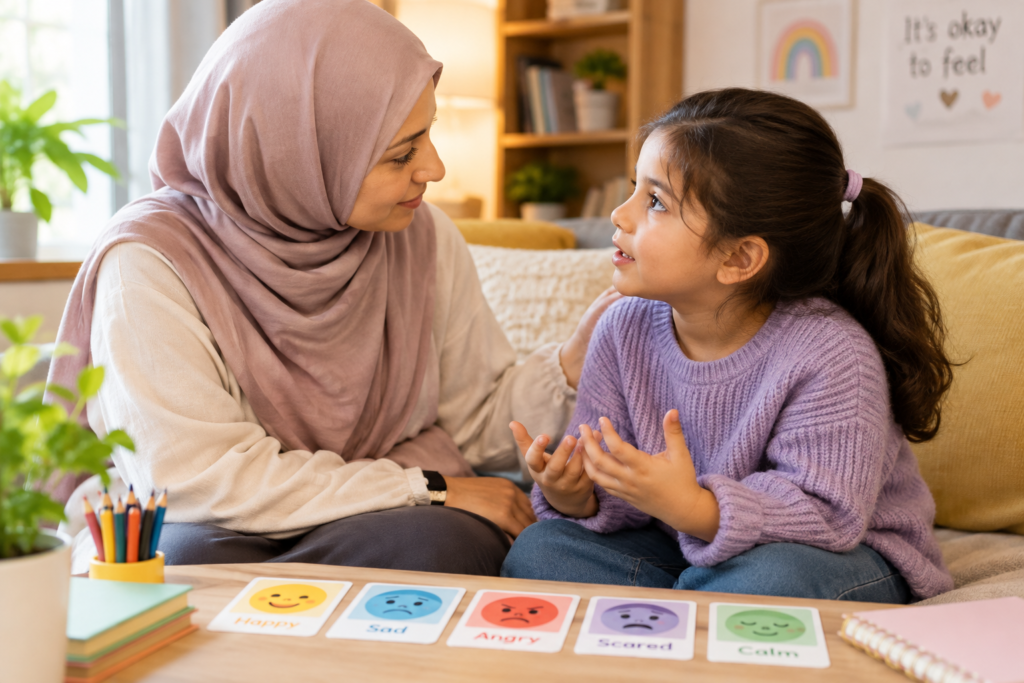
One simple way to teach children about feelings is to give emotions names. Young children often need help connecting their experiences with specific emotional words.
Instead of asking only, “What is wrong?” try using simple words such as happy, sad, angry, scared, worried, excited, confused, disappointed, or frustrated.
For example, if your child loses a favorite toy, you might say, “You seem really sad because you cannot find your toy.”
This helps the child connect the situation with the emotion. Over time, children begin using these words themselves.
I believe parents should introduce emotional vocabulary during normal daily conversations rather than waiting for a difficult situation. You can talk about feelings while reading stories, watching age appropriate programs, playing games, or discussing something that happened during the day.
Teach Children That All Feelings Are Okay
A very important part of emotional development is teaching children that feelings are not something to be ashamed of.
Children should understand that it is okay to feel angry, sad, scared, nervous, or disappointed. What matters is learning how to handle those feelings safely.
For example, you can tell your child, “It is okay to feel angry, but it is not okay to hit someone.”
This simple difference teaches an important lesson. The emotion itself is acceptable, while harmful behavior needs boundaries.
Avoid telling children things like “Do not cry” or “You should not be scared.” These statements can make children feel that their emotions are wrong.
Instead, acknowledge the feeling and then help them find a healthy way to manage it.
Listen Without Immediately Trying to Fix Everything
Sometimes children simply want someone to listen.
As parents, it can be tempting to immediately give advice or solve a problem. However, children often need emotional support before they are ready for solutions.
If your child says, “Nobody wants to play with me,” instead of immediately saying, “That is not true,” you could respond with, “That sounds really upsetting.”
This shows that you are listening and taking their feelings seriously.
When children feel heard, they are more likely to continue talking. This can gradually build trust between parents and children.
Use Everyday Situations as Learning Opportunities
Everyday life provides many opportunities to teach children about feelings.
If your child is excited about a birthday, talk about excitement. If they are nervous before going to school, discuss nervousness. If they lose a game, help them understand disappointment.
These moments can become small emotional lessons.
For example, after a disagreement between siblings, you might ask, “How did you feel when your brother took your toy?”
You can then ask, “What could you say next time instead of shouting?”
This teaches children that emotions can be communicated through words.
Teach Children Simple Sentences for Expressing Feelings
Some children know what they feel but do not know how to say it. Parents can make communication easier by teaching simple sentences.
Children can learn phrases such as:
“I feel sad because…”
“I feel angry when…”
“I am worried about…”
“I do not like it when…”
“I need some help.”
“I need some quiet time.”
These simple expressions give children a starting point.
With practice, children can become better at explaining the reason behind their emotions instead of expressing everything through crying or anger.
Encourage Drawing and Creative Activities
Not every child wants to talk about feelings directly. Some children express themselves more easily through drawing, writing, playing, or other creative activities.
You can ask your child to draw a picture of how they feel. Younger children can also use different facial expressions to identify emotions.
For example, you could draw a happy face, sad face, angry face, and worried face and ask your child which one matches their mood.
Older children may enjoy keeping a simple feelings journal. They can write about something that happened during the day and describe how it made them feel.
Creative activities can make emotional conversations feel natural rather than stressful.
Model Healthy Emotional Expression
Children learn a lot by watching adults.
If parents calmly express their own emotions, children can learn from that behavior. This does not mean parents need to share every personal problem with their children. It simply means showing that emotions can be communicated respectfully.
For example, a parent might say, “I am feeling a little frustrated because I have had a busy day. I am going to take a few minutes to relax.”
This teaches children that feeling frustrated is normal and that people can respond to emotions in healthy ways.
Children often copy what they see more than what they are told. That is why parents should try to demonstrate the communication skills they want their children to develop.
Give Children Time to Calm Down
When a child is extremely angry or upset, they may not be ready for a long conversation.
Trying to force a child to explain their feelings while they are overwhelmed can sometimes make the situation worse.
Give them a little time to calm down. Stay nearby if they need support and let them know that you are available to talk.
Once the child is calmer, you can discuss what happened.
You might say, “Now that you feel a little calmer, can you tell me what made you upset?”
This approach teaches children that calming down can be part of handling strong emotions.
Avoid Judging Their Feelings
Children need to feel safe when they share emotions.
If a child says they are scared of something that seems small to an adult, avoid laughing at them or calling the fear silly.
Instead, try to understand why the situation feels difficult to them.
You can say, “I understand that this feels scary to you. Let us talk about it.”
Even when you cannot change the situation, you can show your child that their feelings deserve respect.
This does not mean agreeing with every reaction. It means listening before correcting.
Teach Healthy Ways to Handle Anger
Anger is one of the emotions children may struggle with the most.
Children can be taught several safe ways to handle anger. They can take slow breaths, move to a quiet place, talk to a trusted adult, count slowly, draw, or take a short break.
The goal is not to teach children that anger is bad. The goal is to teach them that anger can be handled without hurting themselves or other people.
Parents can also help children identify early signs of anger, such as a tight feeling in the body, a louder voice, or the desire to hit or shout.
Recognizing these signs early can make it easier for children to use healthy coping strategies.
Ask Open Questions
The questions parents ask can make emotional conversations easier.
Instead of asking questions that can be answered with only yes or no, try open questions.
You might ask:
“What happened today that made you happy?”
“What was the hardest part of your day?”
“Was there anything that made you worried?”
“What made you feel proud today?”
“How did you feel when that happened?”
These questions encourage children to think about their experiences and put their feelings into words.
Be Patient With Emotional Development
Every child develops emotional communication skills at a different pace. Some children talk openly about their feelings, while others need more time and encouragement.
Parents should not expect immediate changes.
If your child does not want to talk, give them some space and try again later. Continue creating opportunities for conversation without making them feel pressured.
Small conversations can have a big impact when they happen consistently.
Build a Home Where Feelings Can Be Discussed
A child who knows that home is a safe place to discuss emotions may become more comfortable communicating difficult feelings.
Simple routines can help. You could have a short conversation at bedtime about the best and hardest part of the day. During family meals, you can ask everyone to share one thing they enjoyed.
These habits make emotional communication part of normal family life.
Over time, children may become better at identifying their feelings, explaining what caused them, and asking for support when they need it.
Final Thoughts
Teaching children to express their feelings takes patience, understanding, and regular practice. Children need more than emotional vocabulary. They need adults who listen, respect their emotions, set healthy boundaries, and show them how feelings can be communicated safely.
In my opinion, one of the most important things parents can give their children is the confidence to say what they are feeling without being afraid of judgment. When a child knows that their parents will listen, even when the emotion is difficult, communication becomes easier.
Start with simple words. Listen carefully. Give children time to calm down. Encourage healthy ways of expressing emotions and remember that your own behavior is one of their strongest teachers.
Children may not learn emotional expression in one day, but with consistent support, they can gradually develop the skills they need to understand themselves and communicate better with the people around them.