 octopushas3hearts
Related Articles



Teaching children to help around the house is one of the simplest ways I believe parents can prepare them for everyday life. Chores are not only about keeping the home clean. They can help children develop responsibility, independence, confidence, organization, and useful practical skills.
In my opinion, children should not be expected to do everything perfectly from the beginning. The goal is to give them age appropriate chores that match their abilities and allow them to learn gradually. When children are given reasonable household responsibilities, they can start understanding that everyone in the family has a role to play.
Choosing the right chores for children depends on their age, personality, physical abilities, and level of maturity. A task that is suitable for one child may be too difficult or too easy for another. Parents should therefore use age guidelines as a starting point rather than a strict rule.
Why Are Chores Important for Children?
Children learn many important lessons through everyday household tasks. When a child puts toys away, helps set the table, or folds clothes, they are learning that their actions can make a difference.
Age appropriate chores can also teach children responsibility. Instead of parents doing everything for them, children gradually learn to take care of their own belongings and contribute to the household.
Chores can also improve independence. A young child who learns to put away toys may eventually learn to organize a bedroom, prepare simple food, or manage personal belongings.
Another benefit is confidence. Completing a task successfully can give children a sense of achievement. Even a simple chore can make a child feel capable and useful.
Chores for Children Ages 2 to 3
Toddlers are naturally curious and often want to copy what adults are doing. This is a great time to introduce very simple chores for children.
At this age, chores should be short, simple, and supervised. Parents should focus more on teaching the habit than expecting perfect results.
Suitable chores for toddlers include putting toys into a box, placing books on a shelf, carrying dirty clothes to a laundry basket, wiping small spills with a cloth, and helping put away simple items.
A toddler may not complete a task perfectly, and that is completely normal. I think parents should be patient and encouraging at this stage. If a child puts only some toys away, praise the effort and gently help them finish.
Chores for Children Ages 4 to 5
Children between four and five years old can usually handle slightly more responsibility. They can follow simple instructions and understand basic household routines.
Age appropriate chores for this group can include making the bed with help, putting away toys, organizing books, placing clothes in a laundry basket, setting napkins on the table, helping feed a pet with supervision, and wiping surfaces with a safe cloth.
This is also a good age to teach children how to clean up after themselves. For example, if they make a mess while playing, they can learn to put everything back when they are finished.
Parents should still supervise tasks involving pets, cleaning products, kitchens, or anything that could create a safety risk.
Chores for Children Ages 6 to 8
Children from six to eight years old can usually take on more regular household responsibilities. At this age, parents can begin creating a simple chore routine.
Suitable chores may include making the bed, putting clothes away, setting and clearing the table, sweeping small areas, watering plants, organizing toys, helping with groceries, folding simple clothing items, and keeping their bedroom reasonably tidy.
Children in this age group can also begin learning basic organization skills. For example, you can give them a small weekly responsibility such as organizing their school supplies or checking that their books are in the right place.
I find that consistency is particularly important at this stage. A child is more likely to develop a habit when the same chore is performed regularly.
Chores for Children Ages 9 to 11
Children between nine and eleven can often handle more complicated household tasks. They may be able to complete chores with less supervision once they understand what is expected.
Age appropriate chores for this age group can include vacuuming, sweeping and mopping suitable areas, folding laundry, putting clothes away, cleaning their room, taking out household trash when appropriate, washing dishes with supervision, helping prepare simple meals, and caring for household plants.
This is also a useful stage for teaching children how to manage several responsibilities. For example, they might have a daily chore and one weekly chore.
Parents can also involve children in planning. Asking them which chores they prefer can make them feel more involved and responsible.
Chores for Children Ages 12 to 14
As children become teenagers, they can usually handle more independent household responsibilities. They are capable of learning skills that they will eventually need when living on their own.
Teenage chores can include doing laundry, cleaning bathrooms with appropriate products and supervision, vacuuming and mopping floors, washing dishes, preparing simple meals, organizing personal spaces, taking care of pets, and helping with grocery shopping.
Teenagers can also learn how to keep shared areas clean. Instead of focusing only on their bedroom, they can understand that common spaces are everyone’s responsibility.
At this age, I believe parents should gradually move from doing tasks for their children to teaching them how to do tasks independently.
Chores for Teenagers Ages 15 and Older
Older teenagers can usually learn many of the household skills that adults use every day. Their chores can become more practical and independent.
Examples include preparing family meals, doing complete laundry cycles, cleaning bathrooms, vacuuming the house, maintaining their personal space, helping with grocery shopping, washing dishes, organizing household supplies, and helping with basic outdoor work when safe.
Teenagers can also learn practical skills such as planning meals, creating shopping lists, caring for clothing, and keeping track of household responsibilities.
The purpose is not to turn teenagers into unpaid housekeepers. Instead, the purpose is to help them become responsible and capable adults.
How to Introduce Chores Without Creating Stress
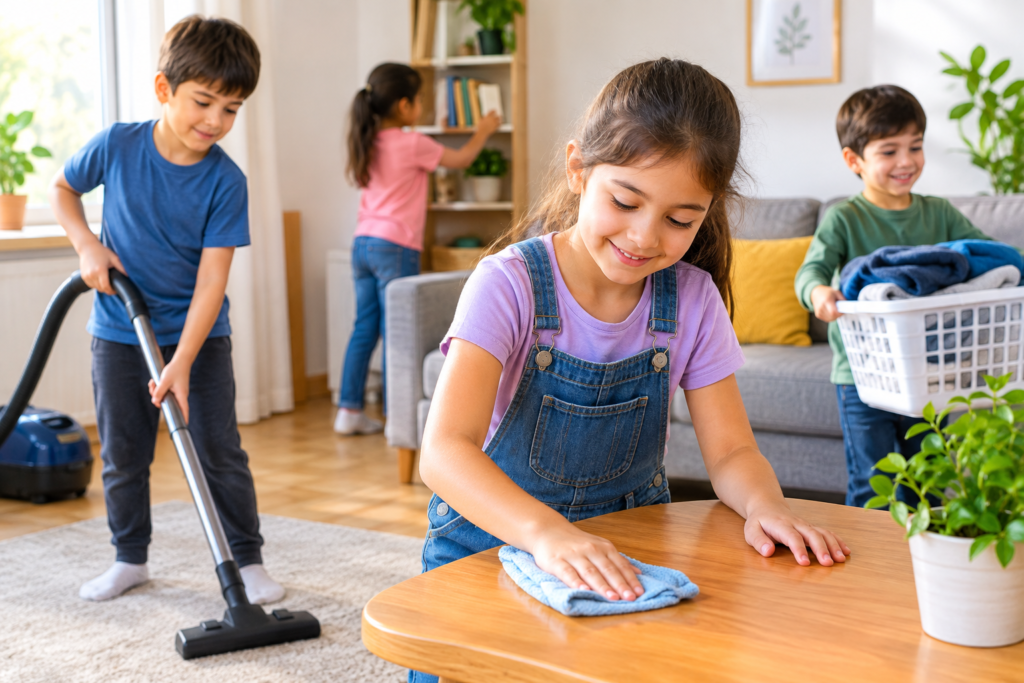
Introducing chores should be a gradual process. If children suddenly receive a long list of responsibilities, they may feel overwhelmed.
I recommend starting with one or two simple chores. Once the child becomes comfortable with them, parents can introduce another responsibility.
It is also important to explain exactly what you expect. Instead of saying, “Clean your room,” give clear instructions such as putting toys away, placing dirty clothes in the basket, and arranging books on the shelf.
Children need to know what completing a chore actually means.
Make Chores Part of the Daily Routine
Children often respond better to chores when they become part of their normal routine. For example, toys can be put away before bedtime, dirty clothes can go into the laundry basket after changing, and the table can be cleared after meals.
A predictable routine makes household responsibilities feel normal rather than like a punishment.
Parents can also create a simple chore chart for younger children. Pictures or checkboxes can make the routine easier to understand and more enjoyable.
Should Children Get Paid for Chores?
There is no single answer that works for every family. Some parents give children an allowance for certain chores, while others believe household responsibilities should be completed simply because everyone contributes to the home.
Personally, I think both approaches can work depending on the family. One useful option is to separate normal family responsibilities from extra jobs.
For example, keeping a bedroom tidy can be considered a normal responsibility, while helping with an additional project could be connected to an allowance.
The most important lesson should remain responsibility rather than money.
Avoid Expecting Perfection
One mistake parents can make is expecting children to complete chores exactly like adults. Children are still learning.
A young child may fold clothes unevenly or sweep without getting every corner. Instead of immediately correcting everything, parents can show them how to improve.
Constructive guidance works better than constant criticism. When children feel that their effort is appreciated, they are more likely to continue helping.
Keep Safety in Mind
Safety should always come before completing a chore. Children should not handle dangerous chemicals, sharp tools, hot appliances, heavy objects, or other unsafe items without appropriate supervision.
Parents should choose chores based on the child’s actual abilities rather than age alone.
It is also important to teach children how to use household equipment safely. Before assigning a task, demonstrate it and make sure the child understands what to do.
Encourage Teamwork
Chores can become a positive family activity when everyone participates. Parents can work alongside younger children while older children can complete certain tasks independently.
Family teamwork also helps children understand that maintaining a home is a shared responsibility.
Instead of presenting chores as something unpleasant that children must do, parents can explain that every member of the family contributes in different ways.
Final Thoughts
Age appropriate chores for children can teach valuable life skills that go far beyond cleaning the house. When children learn to organize their belongings, care for their personal spaces, help with meals, and contribute to family responsibilities, they gradually become more independent.
The best approach is to start small, choose chores that match the child’s abilities, provide clear instructions, and increase responsibility as the child grows.
In my view, the goal of children’s chores should never be perfection. The real goal is learning. A child who learns how to take responsibility for small tasks today can develop the confidence and practical skills needed for bigger responsibilities in the future.
With patience, encouragement, and a consistent routine, household chores can become a natural and valuable part of childhood.