 octopushas3hearts
Related Articles


Parenting can be one of the most rewarding parts of life, but it can also test our patience. There are moments when a child refuses to listen, throws a tantrum, talks back, breaks a rule, or keeps repeating the same behavior even after being corrected. In these situations, staying calm can feel much harder than it sounds.
From my point of view, staying calm when your child misbehaves does not mean ignoring bad behavior or allowing a child to do whatever they want. It means learning how to respond instead of reacting immediately with anger. A calm parent can set clear limits while still helping the child understand their feelings and behavior.
In this article, I will share practical parenting tips that can help parents stay calm, handle difficult behavior, and build a healthier relationship with their children.
Understand Why Children Misbehave
The first step in learning how to stay calm when your child misbehaves is understanding that children do not always behave badly simply because they want to challenge their parents.
Children may misbehave because they are tired, hungry, frustrated, bored, overwhelmed, or unable to express their feelings properly. Young children are still developing emotional control, communication skills, and problem solving abilities.
For example, a child may start crying because you asked them to leave the playground. To an adult, leaving the playground may seem like a simple request. To the child, however, ending a fun activity can feel disappointing.
When I look at difficult behavior this way, it becomes easier to pause before becoming angry. Understanding the reason behind behavior does not mean accepting inappropriate actions. It simply helps us respond more thoughtfully.
Take a Moment Before Responding
One of the simplest ways to stay calm during child misbehavior is to pause before speaking.
When a child is shouting or refusing to cooperate, our first reaction may be to raise our voice. Instead, take a few seconds to breathe and collect your thoughts.
You can take a slow breath, relax your shoulders, and remind yourself that you are the adult in the situation. You do not have to match your child’s emotional energy.
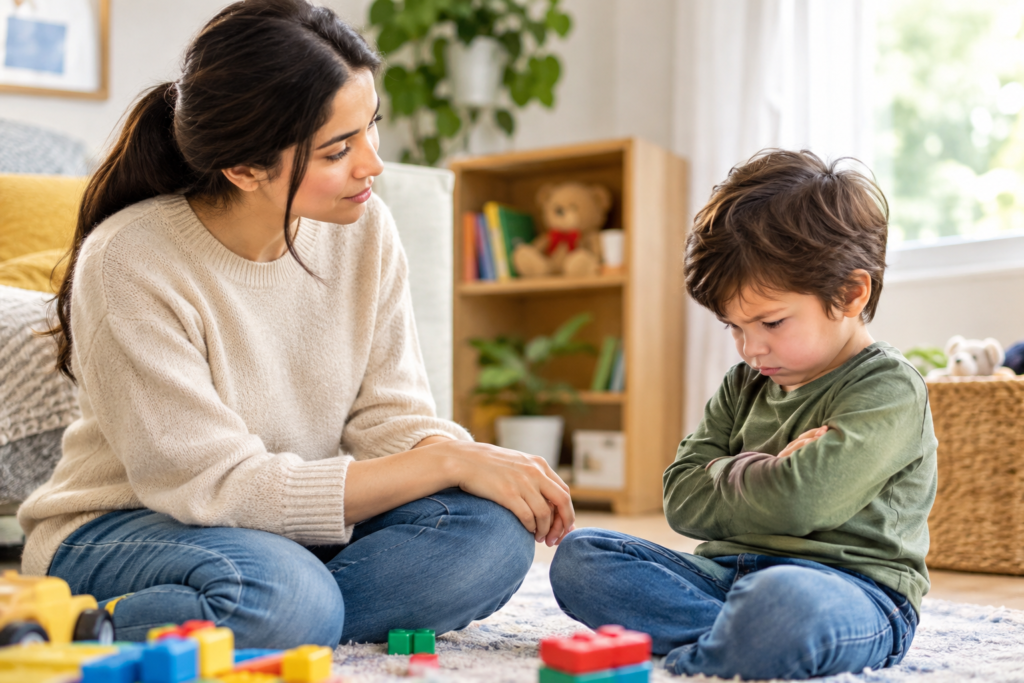
Even a short pause can change the way you respond. Instead of shouting, you may be able to say, “I understand that you are upset, but hitting is not okay.”
This small change can make discipline more respectful and effective.
Keep Your Voice Calm
Children often notice our tone of voice more than the actual words we use. If a parent becomes very loud, the child may become more upset instead of understanding the lesson.
A calm voice does not mean a weak voice. You can speak firmly without shouting.
For example, instead of saying, “Stop doing that right now! How many times do I have to tell you?” you can say, “I have told you that throwing toys is not safe. Please put the toy down.”
The second approach communicates the same boundary without increasing the emotional tension.
Do Not Take Every Behavior Personally
Sometimes parents feel that their child’s misbehavior is a personal attack. A child who says “No” repeatedly or refuses to follow instructions can make a parent feel disrespected.
However, children are still learning how to communicate and control their emotions.
When my patience is tested, I find it helpful to remember that the behavior is not necessarily about me. The child may be struggling with frustration, independence, or disappointment.
This mindset can make it easier to separate the child’s behavior from our own emotions.
Set Clear and Simple Rules
Children need to know what is expected from them. If rules are unclear, changing, or overly complicated, children may have difficulty following them.
Try to create a few simple family rules. For example:
“Use gentle hands.”
“Speak respectfully.”
“Put toys away after playing.”
“Do not run near the road.”
Simple rules are easier for children to remember.
It is also important to apply rules consistently. If a behavior is unacceptable one day but ignored the next day, children may become confused about expectations.
Focus on the Behavior, Not the Child
One important parenting principle is to correct the behavior without labeling the child.
There is a big difference between saying, “You are a bad child” and saying, “That behavior is not acceptable.”
The first statement attacks the child’s identity. The second statement focuses on an action that can be changed.
Children need to understand that making a mistake does not make them a bad person.
Instead of saying, “You are always naughty,” try saying, “Throwing your brother’s toy was not okay. Let’s talk about what happened.”
This approach teaches responsibility while protecting the child’s sense of self worth.
Use Natural and Logical Consequences
Consequences can help children understand that actions have results. However, consequences should be reasonable and connected to the behavior whenever possible.
For example, if a child repeatedly throws a toy, the toy may need to be put away for a while. If a child refuses to clean up after playing, they may need to finish cleaning before starting another activity.
The goal is not to make the child suffer. The goal is to help them understand responsibility.
A calm explanation can make the consequence more meaningful.
You can say, “The blocks are being thrown, so we are putting them away for now. We can try again later when you are ready to play safely.”
Avoid Long Arguments
When children are upset, long explanations often do not work well. The more a parent argues, the more frustrated everyone can become.
If your child keeps saying “No,” you do not necessarily need to explain the same rule ten different ways.
Give a short and clear response.
“I know you want to keep playing. It is time to go home.”
If the child continues protesting, calmly repeat the boundary rather than starting a long argument.
This technique can help prevent a small disagreement from becoming a major conflict.
Give Yourself Permission to Step Away
Sometimes the best way to stay calm is to create a little space.
If your child is safe, take a short moment in another room to breathe and regain control. You might drink some water, count slowly, or simply sit quietly for a minute.
Taking a short break is not the same as abandoning your parenting responsibility. It can be a healthy way to prevent yourself from reacting in anger.
If the situation is unsafe, stay nearby and focus first on keeping everyone safe.
Look After Your Own Emotional Health
Parents also have emotional needs. Lack of sleep, constant responsibilities, work pressure, and household stress can make patience much harder.
From my perspective, parents should not expect themselves to remain perfectly calm every second. We are human too.
Getting enough rest when possible, taking short breaks, talking to someone you trust, and making time for simple activities you enjoy can help improve emotional patience.
Self care is not selfish. A parent who has opportunities to recharge may find it easier to respond calmly during difficult moments.
Teach Children About Feelings
Children who learn to identify their emotions can gradually become better at communicating them.
You can teach simple words such as angry, sad, worried, disappointed, excited, and frustrated.
When your child is upset, you might say, “You seem angry because we have to stop playing.”
This does not mean you are giving permission for inappropriate behavior. You are helping the child understand what they are feeling.
Over time, children can learn that instead of hitting, screaming, or throwing things, they can use words to express themselves.
Notice Good Behavior
Parents often pay attention when children misbehave but forget to notice when they behave well.
Positive attention can encourage children to repeat appropriate behavior.
For example, if your child shares a toy, waits patiently, helps clean up, or speaks politely, acknowledge it.
You can say, “Thank you for putting your toys away without being asked.”
Specific praise helps children understand exactly what behavior you appreciate.
Do Not Expect Perfection
One of the biggest lessons I believe parents can learn is that children are still learning. They will make mistakes. They will test boundaries. They will sometimes behave in ways that are frustrating.
The goal is not to create a child who never misbehaves. The goal is to teach children how to make better choices over time.
Parents also make mistakes. There may be moments when you lose your patience or speak too harshly. If that happens, you can repair the situation.
You might say, “I was very frustrated and I raised my voice. I am sorry for shouting. We still need to follow the rule, but I should have spoken calmly.”
This teaches children that adults can take responsibility too.
Know When Behavior Needs Extra Attention
Occasional tantrums, arguments, and emotional outbursts can be part of growing up. However, if a child’s behavior is severe, persistent, dangerous, or significantly affecting family life, school, friendships, or daily activities, it may be useful to discuss the situation with a qualified pediatrician, child psychologist, counselor, or other appropriate professional.
Seeking guidance does not mean a parent has failed. Sometimes families simply need additional support and practical strategies.
Final Thoughts
Learning how to stay calm when your child misbehaves is a process. It takes patience, practice, and self awareness.
For me, the most important idea is to remember that discipline is not only about stopping unwanted behavior. It is also about teaching children how to manage emotions, respect boundaries, solve problems, and make better choices.
When a child misbehaves, take a breath before reacting. Try to understand what may be behind the behavior, speak calmly, set clear boundaries, and focus on teaching rather than simply punishing.
No parent handles every situation perfectly. What matters is continuing to learn and improve.
A calm response today may not solve every behavior immediately, but it can help create a home environment where children feel safe, understood, and guided. With consistency and patience, difficult moments can become valuable opportunities for both parents and children to learn and grow.