 octopushas3hearts
Related Articles


I believe children learn best when learning feels natural, enjoyable, and connected to their everyday lives. Young children do not always need expensive toys, complicated lessons, or long study sessions to learn something useful. In my experience, some of the best learning opportunities can happen right at home with simple activities that encourage children to explore, ask questions, create things, and solve small problems.
Parents often look for easy learning activities for young children at home because they want to support their child’s development without making learning feel like school. The good news is that many useful activities require very little preparation. A few household items, some creativity, and a little time together can turn an ordinary afternoon into a valuable learning experience.
Why Learning Activities at Home Matter
Home is a child’s first learning environment. Children are naturally curious, and they learn by watching, touching, listening, asking questions, and trying things themselves. Simple learning activities can support language development, early math skills, creativity, memory, problem solving, and social skills.
I also think that parents should focus more on making learning enjoyable rather than trying to teach everything at once. A young child may learn more from a ten minute activity that they genuinely enjoy than from an hour of something they find boring.
The goal is not to create a classroom at home. The goal is to make everyday moments meaningful.
1. Read Picture Books Together
Reading is one of the easiest learning activities for young children at home. You do not need a large collection of books. Even one favorite picture book can become a useful learning tool.
While reading, I recommend asking simple questions such as, “What do you see?” “What do you think will happen next?” or “Why is the character happy?”
Point to different objects in the pictures and ask your child to name them. Talk about colors, animals, numbers, and actions shown in the story.
This activity helps children develop vocabulary, listening skills, imagination, and communication. It can also help create a positive relationship with books from an early age.
2. Practice Counting With Household Objects
Early math does not have to involve worksheets. Children can practice counting using objects they see every day.
You can ask your child to count spoons, toys, blocks, pencils, or pieces of fruit. Start with small numbers and gradually make the activity more challenging.
For example, place five toys on a table and ask your child to count them. Then remove one and ask how many are left.
I like this approach because children can physically touch and move the objects while learning numbers. This makes basic math concepts easier to understand.
3. Create a Color Sorting Game
Color sorting is another simple activity that can be done with everyday objects. Collect safe items in different colors and ask your child to place similar colors together.
You might have red, blue, green, and yellow objects and create separate groups for each color.
You can make the activity more interesting by asking questions such as, “Which group has more?” or “Can you find something yellow in the room?”
This combines color recognition with early counting and observation skills.
4. Draw and Color Together
Drawing is not only an art activity. It also supports creativity, hand control, and self expression.
Give your child paper and crayons and let them draw whatever they want. You can also suggest simple subjects such as a house, tree, family, animal, or favorite toy.
Instead of correcting the drawing, I think it is better to ask the child about it. Ask, “Tell me about your picture.” This encourages communication and allows the child to explain their ideas.
There does not need to be a perfect result. The learning comes from the process.
5. Build With Blocks
Building blocks are excellent for developing early problem solving skills. Children can build towers, houses, bridges, roads, or anything else they can imagine.
Ask your child to build a tower with a certain number of blocks. You can then count the blocks together.
You can also introduce simple concepts such as tall and short, big and small, above and below, and near and far.
Building activities can also teach children that it is normal for something to fall apart and require another attempt. That is a useful lesson in patience and persistence.
6. Try a Simple Matching Game
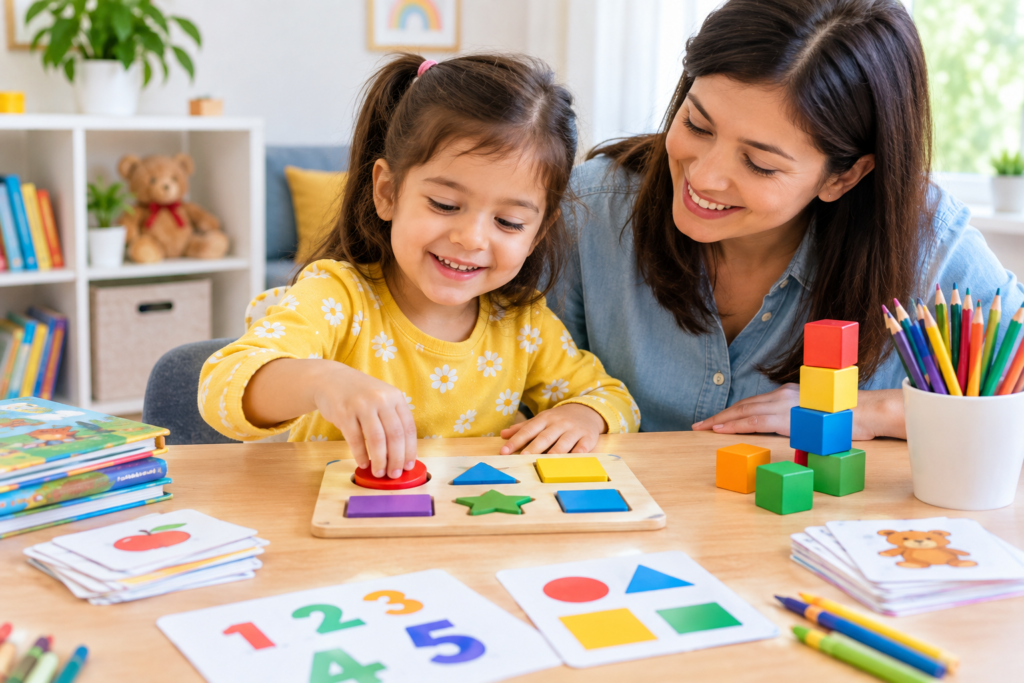
Matching games are easy to prepare at home. You can match socks, pictures, shapes, colors, or similar household objects.
For younger children, start with obvious pairs. As they become more comfortable, introduce objects that require closer observation.
Matching activities can support memory, concentration, visual recognition, and logical thinking.
I find that these games work particularly well when parents participate instead of simply watching. Turn it into a small challenge and celebrate your child when they discover a correct pair.
7. Make Learning About Nature
You do not always have to stay indoors to support learning. A short walk outside can become one of the best learning activities for young children at home and around the home environment.
Ask your child to look for leaves, flowers, birds, insects, rocks, or different types of trees. Talk about what they see and encourage them to describe it.
You can also collect a few safe natural objects and compare their sizes, shapes, and textures.
Nature activities encourage observation and curiosity. They also give children a reason to ask questions about the world around them.
8. Cook Simple Food Together
Cooking can introduce children to many basic learning concepts. While preparing a simple snack, you can talk about numbers, measurements, colors, shapes, and ingredients.
For example, ask your child to count pieces of fruit or identify different ingredients. Older preschool children can help with simple measuring tasks when supervised closely.
Cooking also gives children practical experience and encourages them to follow instructions.
Safety should always come first. Keep young children away from hot surfaces, sharp knives, and other dangerous kitchen equipment.
9. Play With Shapes
Learning shapes can be made into a fun search game. Ask your child to find circles, squares, rectangles, and triangles around the home.
A plate can be used to discuss circles. A book may look like a rectangle. A window might provide another example.
You can also draw different shapes on paper and ask your child to identify them.
Connecting shapes with real objects makes the lesson easier to remember because children can see how the concepts appear in everyday life.
10. Sing Songs and Rhymes
Songs and nursery rhymes are simple but powerful learning tools. Children can learn new words, sounds, numbers, patterns, and movements through songs.
Choose songs that involve actions such as clapping, jumping, counting, or naming body parts.
I especially like activities that combine movement with learning because young children often find it difficult to sit still for long periods. Movement keeps them involved while they practice important skills.
11. Create a Simple Story Together
Storytelling is another excellent activity for language development. You can start with a simple sentence such as, “One morning, a little bird found something unusual.”
Then ask your child what should happen next.
Let them create characters and events. There is no need for the story to make perfect sense. The purpose is to encourage imagination and communication.
You can write down the story afterward and read it back to your child. This can make them feel proud of their ideas and show them how spoken ideas can become written words.
12. Use Everyday Activities as Learning Opportunities
One thing I have learned is that parents do not need to plan every learning activity. Everyday routines already contain many opportunities to teach children.
When cleaning toys, ask your child to sort them by type or color. While getting dressed, talk about different clothing items. During grocery shopping, discuss fruits, vegetables, numbers, and colors.
Even setting the table can become a learning activity. A child can count plates, identify spoons, or match cups with family members.
These moments show children that learning is not limited to books or classrooms.
13. Encourage Puzzles and Simple Problem Solving
Age appropriate puzzles can help children develop concentration and logical thinking. Start with simple puzzles that match your child’s ability.
You can also create your own problem solving challenges. For example, give your child several blocks and ask them to build something that can hold a small toy.
The important thing is to let children try before giving them the answer. A little struggle can be useful because it encourages them to think about different solutions.
14. Keep Activities Short and Enjoyable
One mistake parents sometimes make is expecting young children to concentrate for too long. Children have different attention spans, so activities should be flexible.
If your child enjoys an activity, continue for a little longer. If they become tired or frustrated, take a break and try something else later.
I believe the quality of the interaction matters more than the amount of time spent. Ten focused minutes with a parent can be very meaningful.
15. Praise Effort Instead of Perfection
When children are learning, mistakes are completely normal. Instead of focusing only on whether an answer is correct, praise the effort they make.
Simple words such as “You tried again,” “I like how you solved that,” or “You worked really hard” can encourage children to keep learning.
This can help children develop confidence and become more comfortable with challenges.
Final Thoughts
Easy learning activities for young children at home do not need to be expensive or complicated. Reading books, counting household objects, drawing, building with blocks, sorting colors, playing matching games, exploring nature, singing songs, and telling stories can all support early development.
From my point of view, the most important part is creating a positive learning environment. Children should feel comfortable asking questions, making mistakes, exploring ideas, and trying again.
Parents do not have to be professional teachers to support early learning. What children often need most is time, attention, encouragement, and opportunities to discover things for themselves.
When learning becomes part of everyday family life, children can develop important skills while still enjoying their childhood. A simple game at the kitchen table, a story before bedtime, or a short nature walk can become a valuable learning experience. The key is to keep it simple, stay patient, and let your child’s curiosity guide the way.