 octopushas3hearts
Related Articles



As a parent, I believe some of the most important learning in a child’s life happens at home. Children do not need expensive toys, complicated activities, or a perfect learning environment to develop important skills. What they need most is attention, encouragement, patience, and regular opportunities to explore the world around them.
Supporting child development at home can be much simpler than many parents think. Everyday activities such as talking, reading, playing, drawing, helping with household tasks, and spending quality time together can support a child’s physical, emotional, social, language, and thinking skills.
Every child develops at a different pace, so I believe parents should focus less on comparison and more on creating a positive environment where their own child can learn and grow comfortably. In this article, I will share some simple ways to support your child’s development at home.
Talk to Your Child Every Day
One of the easiest ways to support child development is simply to talk with your child. Children learn language by hearing words and using them in everyday situations.
Parents can talk about almost anything. You can describe what you are cooking, explain what you are doing around the house, or ask your child about something they saw during the day. Even simple conversations can introduce new words and ideas.
I think it is also important to listen carefully when children speak. Give them time to finish their thoughts instead of correcting every small mistake. When children feel that their words matter, they often become more confident communicators.
For younger children, parents can name objects around the house and describe colors, shapes, sounds, and actions. As children grow, conversations can become more detailed and can include questions about their opinions, feelings, and experiences.
Read Books Together
Reading is another simple activity that can make a big difference in a child’s development. You do not need a large home library. A few age appropriate books can provide plenty of opportunities for learning.
When reading with a child, I prefer making the experience interactive rather than simply reading every word on the page. Ask questions such as, “What do you think will happen next?” or “Why do you think the character did that?”
Picture books are especially useful for younger children because they can identify objects, animals, people, and colors. Older children can discuss characters, stories, and new vocabulary.
Regular reading can support language development, listening skills, imagination, concentration, and early literacy skills. It can also become a wonderful way for parents and children to spend quality time together.
Encourage Play
Play is not just entertainment for children. It is one of the natural ways children explore and understand their surroundings.
I believe parents should give children enough time for free play instead of planning every minute of the day. Building blocks, drawing, pretend games, puzzles, dolls, toy cars, and simple household objects can all encourage creativity and problem solving.
Pretend play can be particularly valuable. A child pretending to be a teacher, doctor, shopkeeper, parent, or chef is practicing communication, imagination, decision making, and social skills.
Parents do not always need to lead the activity. Sometimes it is better to watch the child and allow them to decide what they want to create or explore.
Make Learning Part of Everyday Activities
Learning does not have to feel like school. Many household activities can become learning opportunities.
For example, cooking together can introduce children to numbers, measurements, shapes, textures, and following instructions. Folding clothes can teach sorting and matching. Shopping can introduce basic counting and comparison.
Even cleaning a room can teach responsibility and organization. You can ask your child to group toys according to type, color, or size.
From my point of view, these everyday experiences are useful because children can see how their learning connects to real life.
Give Your Child Small Responsibilities
Children gradually develop independence when they are given responsibilities that match their age and abilities.
Young children may be able to put their toys away, place clothes in a basket, or help set the table. Older children can organize their school materials, help with simple household tasks, or prepare parts of their own meals.
The goal is not to make children do difficult work. The goal is to help them understand that they are capable of contributing.
Parents should expect mistakes when children are learning. If a child does not complete a task perfectly, I believe it is better to encourage their effort and show them how to improve rather than immediately doing everything for them.
Support Physical Development
Physical development is another important part of child development. Children need opportunities to move, play, balance, stretch, and develop coordination.
Depending on the child’s age and safety needs, activities can include walking, dancing, playing with a ball, jumping, drawing, building with blocks, or simple outdoor games.
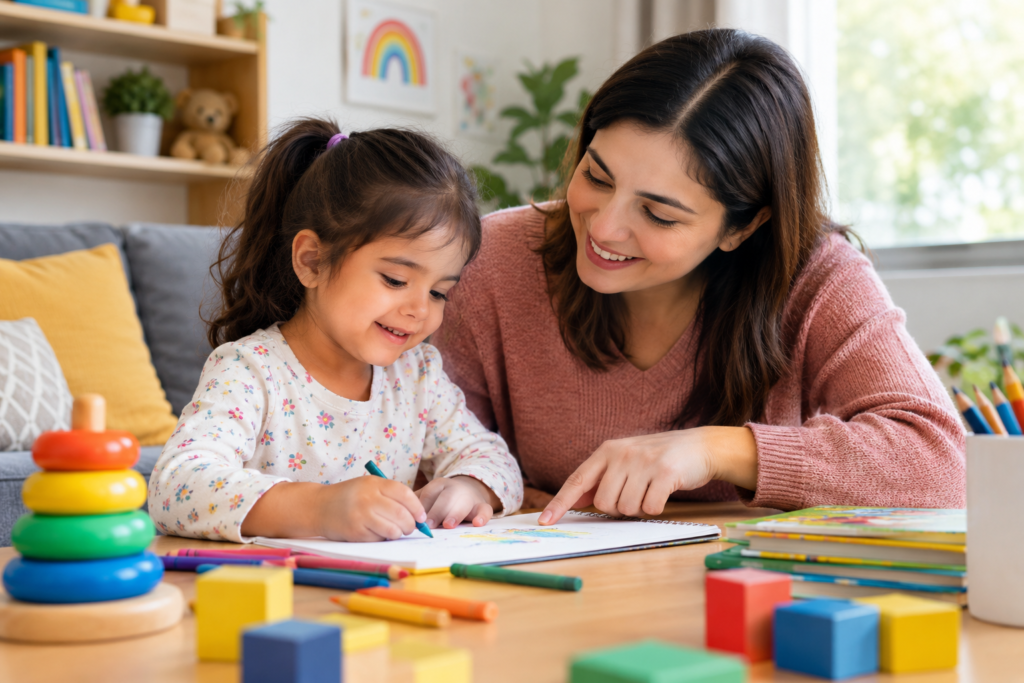
Fine motor skills can also be developed through activities such as coloring, using child safe scissors, playing with building pieces, turning pages, or completing simple puzzles.
Regular physical activity also gives children an opportunity to release energy and enjoy active play.
Teach Children About Feelings
Emotional development deserves just as much attention as academic learning. Children need help understanding what they feel and learning appropriate ways to express those feelings.
Parents can teach children that emotions such as happiness, sadness, anger, fear, and frustration are normal. Instead of telling a child not to feel angry or upset, it can be more helpful to acknowledge the feeling and discuss what happened.
For example, you might say, “I can see that you are frustrated because the toy did not work the way you wanted.”
This teaches children to recognize emotions and communicate them with words.
Over time, children can learn simple strategies for managing difficult emotions, such as taking a break, talking to a trusted adult, taking slow breaths, or moving to a quiet space.
Create a Consistent Routine
Children often feel more comfortable when they know what to expect. A simple daily routine can provide structure without making home life feel too strict.
Regular times for waking, meals, play, learning, relaxation, and bedtime can help children understand the rhythm of their day.
A consistent bedtime routine can be especially helpful. Reading a book, talking quietly, preparing for bed, and reducing stimulating activities before bedtime can create a calm transition.
Routines may look different in every family. What matters most is finding a realistic routine that works for your household.
Limit Distractions During Family Time
Technology can be useful for education and communication, but children also need direct interaction with parents and other people.
I think one simple approach is to create certain periods when the family focuses on being together without unnecessary phone or television distractions.
During meals, reading, conversations, or playtime, putting devices aside can help parents give children their full attention.
The goal does not have to be completely removing screens. Instead, parents can focus on creating a healthy balance between screen based activities and real world experiences.
Encourage Questions
Children naturally ask many questions because they are trying to understand the world.
Sometimes repeated questions can be tiring, but I believe curiosity should be encouraged whenever possible. Instead of immediately giving every answer, parents can sometimes ask children what they think.
For example, if a child asks why plants need water, you can discuss the question together and encourage them to observe what happens when a plant receives proper care.
This approach can support curiosity, reasoning, observation, and problem solving.
Spend Quality Time Together
One of the simplest ways to support your child’s development is to spend meaningful time together.
Quality time does not need to involve expensive activities. You can take a walk, read a story, draw together, play a board game, talk about the day, or simply sit together and listen.
What matters is the attention you give your child.
Children often remember small moments of connection more than expensive gifts. A parent who listens, encourages, and shows genuine interest can have a lasting influence on a child’s confidence and emotional development.
Praise Effort Rather Than Perfection
Children need encouragement, but I think the way we praise them also matters.
Instead of only saying, “You are very smart,” parents can recognize effort and persistence. Statements such as “You worked hard on that” or “You kept trying even when it was difficult” can encourage children to value learning and effort.
This can help children understand that making mistakes is a normal part of learning.
Parents should also avoid comparing one child with another. Every child has different strengths, interests, and developmental patterns.
Create a Safe Environment for Exploration
Children learn by exploring, but they need an environment where exploration can happen safely.
Parents can provide age appropriate materials and make sure dangerous objects are kept out of reach. A safe space can include books, drawing materials, building toys, puzzles, and other simple activities.
It is also useful to allow children to make choices when appropriate. Giving two or three options can help them practice decision making while still maintaining reasonable boundaries.
Be Patient With Your Child’s Development
Every child develops differently. Some children may speak early, while others take more time. Some may enjoy physical activities, while others prefer books, drawing, or building things.
Parents should avoid unnecessary comparisons with siblings, classmates, or other children.
If you have concerns about your child’s development, it is appropriate to discuss them with a qualified pediatrician, teacher, or child development professional. Getting professional guidance can help parents understand whether a child may need additional support.
Final Thoughts
Supporting your child’s development at home does not have to be complicated. In my view, the most valuable things parents can provide are time, attention, encouragement, patience, and opportunities to learn through everyday experiences.
Talk with your child, read together, encourage play, involve them in simple household activities, support their emotions, and give them opportunities to become independent. These small habits can become an important part of healthy child development.
The main thing I would remind parents is that they do not need to be perfect. Children benefit from consistent care and positive relationships, not from a perfectly organized home or a schedule filled with educational activities.
When children feel loved, safe, listened to, and encouraged to explore, they have a strong foundation for learning and growing. Simple moments at home can become meaningful learning experiences, and sometimes the ordinary activities we do together are the ones that support a child’s development the most.