 octopushas3hearts
Related Articles

Understanding the different stages of child development is important for every parent, teacher, and caregiver. Children do not grow and learn in exactly the same way, but there are certain developmental stages that help us understand what children commonly experience as they grow. These stages include physical growth, language development, emotional changes, social skills, and cognitive development.
From my point of view, knowing about child development makes it easier to understand a child’s behavior. A baby who cries frequently, a toddler who wants to do everything independently, or a teenager who wants more privacy may all be showing normal parts of growing up. When parents understand these changes, they can provide better support without expecting children to behave like adults.
In this article, I will explain the major stages of child development and discuss the important changes that usually happen during each stage.
What Is Child Development?
Child development refers to the physical, mental, emotional, social, and language changes that happen as a child grows. Development begins before birth and continues through childhood and adolescence.
Every child develops at their own pace. Some children may begin speaking earlier, while others may take more time. One child may be confident around other people, while another may be more cautious. These differences do not automatically mean that one child is developing better than another.
The main areas of child development include physical development, cognitive development, language development, emotional development, and social development. All of these areas are connected and can influence one another.
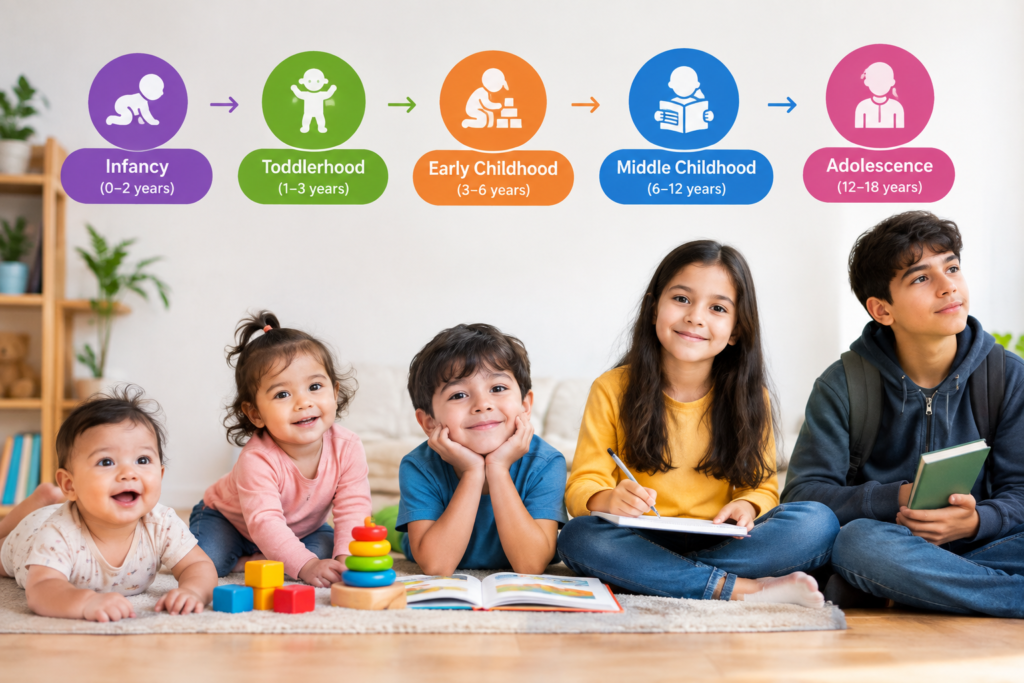
Stage One: Infancy
Infancy generally covers the first two years of life. This is one of the fastest periods of physical and brain development.
During infancy, babies gradually gain control over their bodies. They learn to hold their heads up, roll over, sit, crawl, stand, and eventually walk. Their hand movements also become more controlled as they learn to reach for objects, hold toys, and explore things around them.
Cognitive development is also happening quickly. Babies begin recognizing familiar people and objects. They learn through their senses and become interested in sounds, colors, movement, and different textures.
Language development starts even before a baby can speak words. Babies communicate through crying, facial expressions, gestures, and sounds. They may begin making simple sounds and eventually start saying their first words.
Emotional development is another important part of infancy. Babies develop attachments to their parents and caregivers. They may become upset when separated from familiar people and happy when they see someone they know.
In my opinion, one of the most important things parents can provide during infancy is a safe and responsive environment. Talking to a baby, reading simple books, responding to their needs, and providing opportunities to explore can support early development.
Stage Two: Toddlerhood
Toddlerhood usually covers approximately two to three years, although developmental stages can overlap. This is a period when children become much more independent.
Toddlers often want to do things by themselves. They may want to choose their clothes, feed themselves, pick their toys, or decide what activity they want to do. This growing independence is an important part of development.
Physical development continues as toddlers become better at walking, running, climbing, and using their hands. Their coordination improves and they become more interested in exploring their surroundings.
Language development also grows rapidly during this period. Toddlers may begin using more words and putting words together into short sentences. They often ask many questions because they are trying to understand the world around them.
Emotionally, toddlerhood can sometimes be challenging for parents. Young children may have strong emotional reactions because they have not yet developed the ability to manage their feelings effectively. Frustration can quickly turn into crying or anger.
I believe parents should be patient during this stage. Instead of expecting a toddler to control emotions like an adult, it is more helpful to teach them simple ways to express what they feel.
Stage Three: Early Childhood
Early childhood generally includes the preschool years, often from around three to six years of age. Children become more confident, curious, and active during this stage.
Physical skills improve significantly. Children may become better at running, jumping, drawing, using scissors, building with blocks, and handling other objects.
Cognitive development is also very noticeable. Children ask questions, enjoy stories, recognize basic numbers and letters, and begin developing early problem solving skills. Their imagination can be very strong, and pretend play becomes an important way of learning.
Language development expands rapidly during early childhood. Children learn new words and become better at explaining their thoughts and experiences. They may enjoy telling stories and asking detailed questions.
Social development also becomes increasingly important. Children begin playing with other children and learning how to share, cooperate, take turns, and follow simple rules.
Emotional development continues as children learn to identify their feelings. They may become proud when they accomplish something and disappointed when something does not go their way.
Parents and teachers can support children by encouraging curiosity. Simple activities such as reading together, drawing, playing games, building with blocks, and talking about everyday experiences can help children learn naturally.
Stage Four: Middle Childhood
Middle childhood usually covers approximately six to twelve years. During these years, children enter a period of more structured learning and increasingly complex social experiences.
Physical growth continues, although the rate may vary considerably from child to child. Children usually become stronger and more coordinated. Many develop interests in sports, outdoor activities, crafts, music, or other hobbies.
Cognitive development becomes more advanced. Children begin to understand more complex ideas and can usually follow instructions involving several steps. They become better at logical thinking and problem solving.
School plays an important role during middle childhood. Children develop reading, writing, mathematics, scientific thinking, and other academic skills. They also start discovering subjects and activities they particularly enjoy.
Social relationships become increasingly important. Friendships can have a strong influence on a child’s experiences and confidence. Children begin to understand cooperation, fairness, responsibility, and social expectations in greater detail.
Emotional development during this stage involves learning how to handle disappointment, frustration, success, and social pressure. Children may also start comparing themselves with their classmates and friends.
From my perspective, encouragement is especially important at this age. Children benefit when adults recognize effort rather than focusing only on grades or achievements. Helping a child understand that mistakes are part of learning can build confidence and resilience.
Stage Five: Adolescence
Adolescence is the stage between childhood and adulthood. It generally begins around puberty and continues through the teenage years. The exact timing varies from person to person.
One of the most noticeable changes during adolescence is physical development. Puberty causes significant changes in the body as children gradually develop into young adults.
Cognitive development also becomes more sophisticated. Teenagers can think about abstract ideas, consider different possibilities, and develop their own opinions about school, relationships, society, and the future.
Emotional development can be complicated during adolescence. Teenagers are developing a stronger sense of identity and may experience changes in confidence, motivation, and emotions. They also begin seeking greater independence from parents.
Social relationships become particularly important. Friendships and peer groups can influence interests and behavior. At the same time, many teenagers begin thinking more seriously about their future education, careers, and personal goals.
I think parents can help most by maintaining open communication. Teenagers need guidance, but they also need opportunities to make appropriate decisions and learn from their experiences. Listening without immediately judging can make it easier for them to discuss important concerns.
The Importance of Emotional Development
Emotional development is an important part of every stage of childhood. Children gradually learn how to recognize feelings, express emotions, understand other people’s emotions, and manage difficult situations.
A young child may need an adult to help them calm down, while an older child may be able to use words to explain their frustration. Teenagers gradually develop more advanced ways of handling emotions and solving interpersonal problems.
Parents can support emotional development by creating a safe environment where children can talk about their feelings. Simple statements such as asking a child what happened or how they feel can encourage communication.
The Importance of Social Development
Social development helps children learn how to interact with other people. It begins with relationships between babies and caregivers and gradually expands to siblings, classmates, friends, teachers, and other members of the community.
Young children learn basic skills such as sharing and taking turns. Older children develop deeper friendships and understand social rules more clearly. Teenagers begin forming more independent relationships and developing their own social identities.
Activities such as group games, teamwork, family conversations, and community activities can give children opportunities to practice social skills.
How Parents Can Support Child Development
Parents do not need expensive toys or complicated activities to support healthy development. Everyday interactions can provide valuable learning opportunities.
Reading with children can improve language and communication skills. Talking about daily activities can expand vocabulary and encourage curiosity. Playing games can develop problem solving and social skills. Outdoor play can support physical development.
A consistent routine can also help children feel secure. Regular sleeping, eating, learning, and play schedules can give children a sense of stability.
Most importantly, children need attention, encouragement, and appropriate guidance. Spending quality time together allows parents to understand their child’s interests, strengths, and challenges.
Why Every Child Develops Differently
One thing I believe parents should always remember is that developmental stages are general guidelines, not strict deadlines. Children develop at different rates because of many factors, including genetics, environment, experiences, relationships, learning opportunities, and individual personality.
A child who develops one skill later than another child is not necessarily behind overall. However, if parents or caregivers have ongoing concerns about a child’s development, it is appropriate to discuss those concerns with a qualified pediatrician or child development professional.
Early conversations can help families understand whether additional evaluation or support may be useful.
Final Thoughts on Child Development
Understanding the different stages of child development helps parents see childhood as a gradual process rather than a series of fixed expectations. From infancy through adolescence, children are constantly learning new skills and developing physically, mentally, emotionally, and socially.
In my view, the best approach is to provide children with love, safety, encouragement, healthy boundaries, and opportunities to learn. Parents should celebrate progress while remembering that every child has an individual developmental journey.
When adults understand the major stages of child development, they can respond to children with greater patience and provide support that matches their age and needs. The goal is not to make every child develop in exactly the same way. The goal is to create an environment where each child has the opportunity to learn, grow, build confidence, and gradually become an independent young person.