 octopushas3hearts
Related Articles


I believe one of the most valuable things parents can give their children is a natural desire to explore and learn. Children are naturally curious. They want to know how things work, why things happen, and what they can discover around them. Sometimes, however, busy schedules, excessive screen time, fear of mistakes, or too much pressure can reduce that curiosity.
Encouraging your child to explore and learn does not mean turning your home into a classroom. In my view, learning becomes more meaningful when children can discover things through everyday experiences. A simple conversation, a walk outside, a book, a household activity, or a question about nature can become a learning opportunity.
Parents play an important role in creating an environment where children feel comfortable asking questions, trying new things, and making mistakes. Here are some practical ways I believe parents can encourage children to become curious, confident, and active learners.
Create a Home That Encourages Curiosity
The home environment can have a major influence on how children approach learning. If books, creative materials, puzzles, building toys, and educational resources are easily available, children have more opportunities to explore their interests.
You do not need to spend a lot of money on expensive educational toys. Simple items can be useful. Paper, pencils, cardboard boxes, building blocks, coloring materials, recycled containers, and age appropriate books can encourage creativity.
I also think parents should allow children to have a small space where they can explore freely. It could be a table, shelf, or corner of a room. The purpose is to give children a place where they can read, draw, build, experiment, or work on projects.
Encourage Your Child to Ask Questions
Questions are one of the strongest signs of curiosity. Children often ask questions throughout the day because they are trying to understand the world around them.
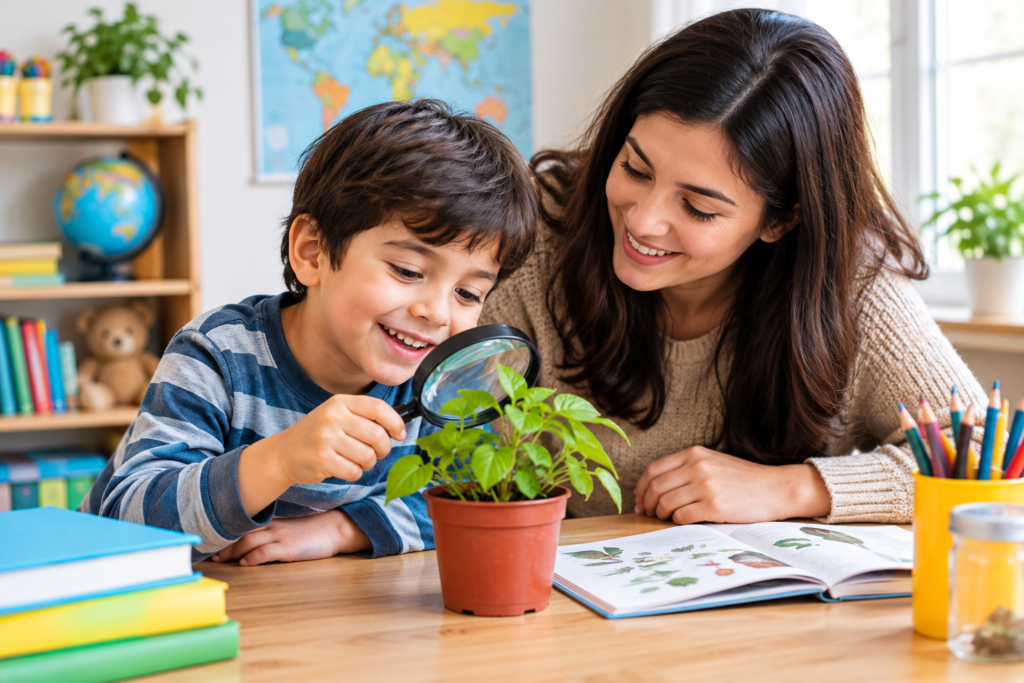
Instead of immediately giving every answer, parents can sometimes encourage children to think first. If your child asks why plants need sunlight, you could ask, “What do you think would happen if a plant stayed in a dark room?”
This simple approach turns a question into a learning experience.
Of course, children need accurate answers when they are unsure. The goal is not to avoid answering them but to encourage them to think, observe, and develop their own reasoning skills.
Let Children Explore Their Interests
Every child is different. One child may love animals, while another may be interested in drawing, machines, sports, music, space, cooking, or technology.
I believe parents should pay attention to these interests rather than forcing every child to enjoy the same activities.
If your child loves dinosaurs, for example, you can introduce books, documentaries, drawings, museum visits, or simple dinosaur related activities. If a child enjoys cooking, measuring ingredients can introduce basic mathematics and science in a natural way.
When children are genuinely interested in something, learning often feels less like work and more like discovery.
Spend Time Outdoors
Outdoor exploration is an excellent way to encourage children to learn. Nature provides countless opportunities for observation and discovery.
A walk in a park can become a lesson about plants, insects, weather, colors, shapes, and animals. Children can collect fallen leaves, observe clouds, look for different types of flowers, or notice changes in the environment.
You can ask questions such as, “Why do you think this leaf is a different color?” or “Which bird do you think made that sound?”
These conversations can help children develop observation skills while making learning enjoyable.
Read Together Regularly
Reading is one of the simplest ways to encourage learning at home. Children who regularly experience books can develop vocabulary, imagination, communication skills, and a wider understanding of the world.
Reading together does not always have to involve long stories. Picture books, science books, magazines designed for children, biographies, and age appropriate educational material can all be useful.
I recommend allowing children to choose some of the books they want to read. Even if their choice is not what you would normally select, their interest can encourage them to spend more time with books.
After reading, talk about the story. Ask what your child liked, what surprised them, or what they think might happen next. These conversations can make reading more interactive.
Turn Everyday Activities Into Learning Opportunities
Learning does not have to happen only during study time. Everyday activities can teach children useful skills.
Cooking can teach measurements and basic science. Shopping can introduce money and simple mathematics. Gardening can teach children about plants and responsibility. Cleaning can teach organization. Planning a family outing can introduce geography and time management.
I find that these everyday experiences can sometimes be more memorable than formal lessons because children can see how knowledge is used in real life.
The important thing is to involve children rather than doing everything for them.
Allow Children to Make Mistakes
One of the biggest barriers to exploration is the fear of making mistakes. If children believe that every activity must be perfect, they may become reluctant to try new things.
Parents can help by treating mistakes as part of learning.
If a child builds something that falls apart, instead of immediately fixing it, ask what they think went wrong. Give them an opportunity to try again.
The same principle applies to schoolwork, drawing, crafts, experiments, and other activities. A mistake does not mean a child has failed. It can provide useful information about what to try next.
Give Children Time to Explore Independently
Parents naturally want to help their children, but helping too much can sometimes reduce independence.
If your child is working on a puzzle or building something, give them enough time to try solving the problem themselves before stepping in.
You can provide guidance when necessary without taking control of the entire activity.
Independent exploration can help children develop problem solving skills, patience, decision making, and confidence.
Use Technology in a Balanced Way
Technology can be a useful learning tool when children use it thoughtfully. Educational videos, interactive learning platforms, digital books, creative software, and age appropriate research tools can introduce children to new subjects.
However, I believe technology works best when it supports active learning rather than replacing it.
After watching an educational video about space, for example, encourage your child to draw the solar system or find information about a planet. After learning about animals, they could create an animal fact sheet.
The goal is to turn passive screen time into an opportunity for curiosity and creativity.
Encourage Creative Activities
Creativity and learning are closely connected. Drawing, painting, music, building, writing, acting, and crafts give children opportunities to express ideas and experiment.
Parents do not need to judge every creative activity based on the final result. The process is often more important.
When a child draws a picture, instead of only asking what it looks like, ask them to explain what they created. This encourages communication and imagination.
Creative activities can also help children become comfortable with trying different ideas.
Ask Open Ended Questions
The way parents communicate with children can influence how they think. Questions that have only one correct answer can be useful, but open ended questions can encourage deeper thinking.
Instead of asking, “Is this a dog?” you could ask, “What do you notice about this animal?”
Instead of asking, “Did you enjoy the story?” you could ask, “What was your favorite part and why?”
These questions encourage children to explain their thoughts rather than simply providing short answers.
Be a Role Model for Learning
Children often learn by watching their parents. If they see adults reading, asking questions, learning new skills, and showing curiosity, they may become more interested in learning themselves.
You do not have to know everything. In fact, saying “I do not know, so let us find out” can be a powerful example.
It teaches children that learning does not stop when someone becomes an adult.
Parents can share their own interests with children, learn something new together, or discuss interesting things they discover during the day.
Celebrate Effort and Curiosity
Praise can influence how children view learning. Instead of focusing only on grades, correct answers, or winning, recognize effort, persistence, creativity, and curiosity.
You might say, “I like how you kept trying,” or “That was an interesting idea.”
This type of encouragement can help children understand that learning is about progress rather than perfection.
It is also important to avoid comparing children with siblings, classmates, or other children. Every child develops different interests and skills at a different pace.
Make Learning Fun
Children are naturally more willing to explore when learning feels enjoyable. Games, challenges, experiments, stories, outdoor activities, and family projects can make education feel exciting.
You can play word games during a car ride, count objects while shopping, identify birds during a walk, or create a simple science experiment at home using safe household materials.
The activity does not have to be complicated. What matters is creating opportunities for children to think, ask questions, and discover something new.
Give Children Choices
Giving children reasonable choices can increase their involvement in learning. For example, instead of deciding everything for them, ask whether they want to read a story, draw a picture, or build something.
You can also let them choose a topic for a small project.
Having some control over their activities can make children feel more responsible for their own learning. Parents can still provide boundaries while allowing children to make age appropriate decisions.
Build a Positive Learning Routine
A simple routine can help children develop consistent learning habits. This does not mean filling every hour with educational activities.
A balanced routine might include time for reading, outdoor play, creative activities, homework, family conversations, rest, and free play.
Children also need unstructured time. Sometimes the best ideas appear when children have the freedom to decide what they want to do.
The goal is to create a healthy environment where learning becomes a natural part of everyday life.
Final Thoughts
In my opinion, encouraging your child to explore and learn starts with something very simple: give them permission to be curious. Children do not need parents who know every answer. They need parents who listen to their questions, support their interests, provide safe opportunities to explore, and encourage them when things do not work the first time.
Reading together, spending time outdoors, asking thoughtful questions, using everyday activities as learning opportunities, and allowing children to make mistakes can all support healthy learning habits.
Most importantly, try to make learning enjoyable. When children associate learning with curiosity, discovery, encouragement, and positive experiences, they are more likely to develop a lifelong interest in understanding the world around them.
As parents, we cannot discover everything for our children. What we can do is create an environment where they feel confident enough to discover things for themselves. That curiosity can become one of the most valuable skills they carry into school, work, and everyday life.