 octopushas3hearts
Related Articles



Teaching children about consequences is one of the most important parts of parenting. Children naturally make mistakes, test boundaries, and learn through experience. Instead of trying to prevent every mistake, parents can help children understand that their choices have results. When children learn about consequences in a calm and supportive way, they gradually develop responsibility, self control, and better decision making skills.
In my view, teaching consequences should not be about frightening children or making them feel guilty. It should be about helping them understand the connection between what they do and what happens next. A child who understands consequences is more likely to think before acting and take responsibility for their choices.
What Are Consequences for Children?
Consequences are the results that follow a child’s actions or decisions. Some consequences happen naturally, while others are created by parents to teach an important lesson.
For example, if a child forgets to put a toy away, the natural consequence may be that the toy is difficult to find later. If a child refuses to wear a jacket in cold weather, they may feel cold. These experiences can help children understand that choices have results.
Parents can also use reasonable consequences when a child’s behavior affects other people or breaks an important family rule. The purpose should always be learning rather than punishment.
Explain the Connection Between Choices and Results
One simple way to teach children about consequences is to explain the connection between their choices and what happens afterward. Young children may not immediately understand this connection, so parents need to use simple language.
For example, instead of saying, “You are being careless,” a parent might say, “You left your crayons on the floor, and now someone could step on them. Let’s put them back in their box.”
This approach helps children focus on their behavior rather than believing that something is wrong with them as a person.
I believe this small difference can make parenting conversations much more productive. The goal is to teach children that they can make better choices next time.
Use Natural Consequences When They Are Safe
Natural consequences can be powerful learning opportunities. They allow children to experience the results of their choices without a parent creating an artificial punishment.
If a child leaves a favorite book outside and it gets wet from rain, they may learn why belongings need to be protected. If a child spends all their playtime and does not leave enough time to get ready for bed, they may experience a rushed evening.
However, parents should never allow a natural consequence when it could seriously hurt a child. Safety always comes first.
Children need opportunities to learn, but they also need adults to protect them from dangerous situations.
Set Clear Rules Before Problems Happen
It is much easier for children to understand consequences when family rules are clear. Children should know what is expected before they make a mistake.
For example, parents can establish simple rules such as putting toys away after playing, speaking respectfully, completing homework before recreational screen time, and helping with age appropriate household tasks.
The rules should be realistic for the child’s age. A young child cannot be expected to follow the same responsibilities as an older teenager.
When rules are clear and consistent, children are less likely to feel confused about why a consequence is happening.
Make Consequences Reasonable
A consequence should match the behavior as closely as possible. If a child makes a small mistake, a huge punishment may teach fear rather than responsibility.
For example, if a child draws on the wall, an appropriate consequence could involve helping clean the wall with an adult. If a child repeatedly leaves toys around the house, they may need to spend some time organizing them before starting another activity.
Reasonable consequences help children see the relationship between their behavior and the result.
In my opinion, this is much more useful than giving unrelated punishments that do not teach the child anything about the original problem.
Avoid Yelling and Humiliation
Teaching children about consequences does not require yelling. In fact, staying calm can make the lesson easier for a child to understand.
When adults become extremely angry, children may focus more on the parent’s emotional reaction than on their own behavior. They may become frightened, defensive, or focused on avoiding punishment.
A calm conversation can be more effective.
Parents can say, “You chose to throw the toy, so the toy needs to be put away for now. We can try again when you are ready to use it safely.”
This communicates a clear boundary without insulting or humiliating the child.
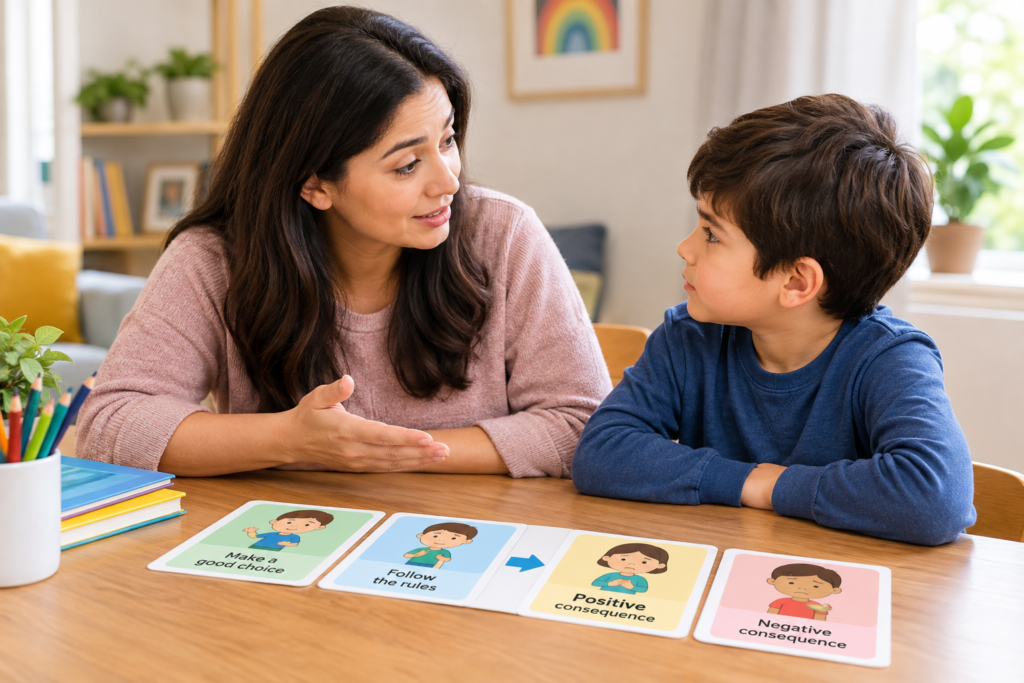
Give Children Choices
Giving children limited choices can help them understand responsibility. Instead of controlling every decision, parents can allow children to make age appropriate choices and experience reasonable results.
For example, a parent might say, “You can finish your homework now and have free time afterward, or you can take a short break first and then complete it.”
The child gets some control while still understanding that the responsibility remains theirs.
As children grow, these small decisions can prepare them for larger choices involving school, friendships, money, work, and personal responsibilities.
Teach Consequences Without Threats
Threats may sometimes produce quick obedience, but they do not always help children understand why a behavior needs to change.
Instead of repeatedly saying, “If you do that again, you will be punished,” parents can explain what will happen in advance.
For example, “If the tablet is not used according to our family rules, we will put it away until tomorrow.”
This makes the consequence predictable rather than frightening. The child understands the rule, the choice, and the result.
Be Consistent With Consequences
Consistency is another important part of teaching consequences. If a rule is enforced one day but ignored the next, children may struggle to understand what is expected.
Consistency does not mean parents must react exactly the same way in every situation. Children have different needs depending on their age, circumstances, and behavior.
It means that important family expectations should generally remain stable.
When parents calmly follow through with reasonable consequences, children learn that rules have meaning and that their actions matter.
Help Children Fix Their Mistakes
One of the best ways to teach responsibility is to encourage children to repair problems when possible.
If a child spills something, they can help clean it. If they hurt someone with unkind words, they can apologize and think about how to communicate differently. If they damage something through careless behavior, they can participate in repairing or replacing it when appropriate.
This teaches children that making a mistake does not mean they are bad. It means they have an opportunity to take responsibility and make things better.
I think this lesson is extremely valuable because everyone makes mistakes throughout life. Children need to learn not only how to avoid mistakes but also how to respond when mistakes happen.
Consider the Child’s Age
Teaching consequences should look different at different ages.
Young children often need very simple explanations and immediate consequences. They may not understand long term results very well.
School age children can usually understand more detailed connections between choices and results. They can take on responsibilities such as organizing belongings, completing schoolwork, and following household routines.
Teenagers can understand more complex consequences. Parents can discuss how decisions may affect friendships, education, money, time management, and future opportunities.
The goal is to gradually move from adult controlled decisions toward independent decision making.
Praise Responsible Behavior
Teaching consequences is not only about correcting mistakes. Parents should also notice when children make responsible choices.
If a child remembers to clean up without being reminded, a parent can acknowledge the effort. If a child admits a mistake honestly, that honesty deserves recognition.
Simple statements such as “I appreciate that you told me the truth” or “You remembered your responsibility today” can reinforce positive behavior.
Children need to know that good choices are noticed too.
Allow Children to Learn From Small Mistakes
Parents naturally want to protect their children from disappointment. However, protecting children from every small consequence can make it harder for them to develop independence.
If a child forgets a school item that is not essential for safety, a parent may allow the child to experience the inconvenience of forgetting it. This can encourage better preparation next time.
Of course, parents should consider the situation carefully. The purpose is not to make children suffer. It is to give them safe opportunities to learn.
Small mistakes can become valuable lessons when adults respond with patience.
Talk About Consequences After Emotions Calm Down
Children may not learn much during a major emotional moment. If a child is angry, crying, or overwhelmed, it may be better to help them calm down before discussing the behavior.
Once everyone is calmer, parents can ask questions such as:
“What happened?”
“What choice did you make?”
“What happened because of that choice?”
“What could you do differently next time?”
These questions encourage children to think rather than simply listen to a lecture.
Teach That Consequences Are Part of Life
One of the biggest lessons parents can give children is that consequences are a normal part of life.
Adults also make choices and experience results. We manage our time, care for our belongings, keep commitments, and deal with the outcomes of our decisions.
Children gradually learn these skills through everyday experiences.
When parents teach consequences with patience, children can develop responsibility without feeling that every mistake is a disaster.
Final Thoughts
Learning how to teach children about consequences is an important part of raising responsible and confident children. The goal should not be to control every action or punish every mistake. Instead, parents can help children understand choices, results, responsibility, and better decision making.
In my view, the most effective approach combines clear rules, reasonable consequences, calm communication, consistency, and plenty of encouragement. Children need boundaries, but they also need patience and opportunities to learn.
A child who makes a mistake should have a chance to understand what happened, take responsibility, and try again. Over time, these everyday lessons can help children become more thoughtful, independent, and prepared for the responsibilities of life.